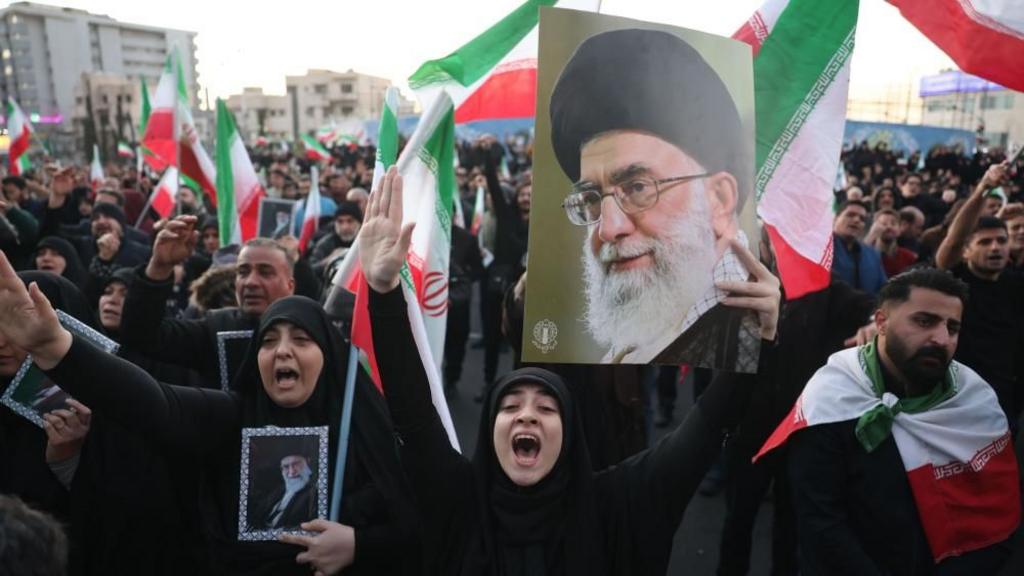
🔥 What Just Happened — The Event in Brief
On February 28, 2026, the geopolitical landscape of the Middle East fundamentally fractured. In a highly coordinated assault, the United States and Israel launched a massive wave of military strikes against the Islamic Republic of Iran, dubbed "Operation Epic Fury" by U.S. President Donald Trump.
The strikes achieved an unprecedented objective: the assassination of Iran's 86-year-old Supreme Leader, Ayatollah Ali Khamenei — a fact subsequently confirmed by Iranian state media.
This was not merely a decapitation strike or a tactical maneuver to delay nuclear enrichment. It marked a profound shift in stated U.S. and Israeli policy — from containment to outright regime change.
To understand what just happened, why it occurred, and where this volatile conflict is heading, one must look past the immediate smoke over Tehran and analyze the hidden patterns of escalation that have defined U.S.–Iran–Israel relations over the past decade.
🕳️ The Hidden Pattern: From Shadow Proxies to Existential War
The defining pattern of this conflict has been the steady, methodical erosion of mutual red lines — transitioning the confrontation from a proxy "shadow war" into a direct, existential, state-on-state conflict.
The Proxy Architecture Iran Built
For decades, Iran and Israel fought indirectly. Iran relied on its "Axis of Resistance" — a network of proxy militias designed to surround and harass Israel while maintaining plausible deniability:
| Proxy | Location | Primary Role |
|---|---|---|
| Hezbollah | Lebanon | Northern front against Israel; Iran's most lethal proxy |
| Hamas | Gaza | Southern front; rocket attacks on Israeli cities |
| Houthis | Yemen | Red Sea disruption; missile attacks on Israel and Gulf shipping |
| PMF (Popular Mobilisation Forces) | Iraq/Syria | Targeting U.S. bases; logistics corridor to Lebanon |
📈 The Escalation Ladder — A Decade of Breaking Red Lines
| Year / Date | Event | Significance |
|---|---|---|
| 2015 | JCPOA signed | Temporary nuclear limits; brief diplomatic window opens |
| 2018 | Trump (Term 1) withdraws from JCPOA | "Maximum Pressure" sanctions begin; Iran abandons nuclear limits; proxy attacks ramp up |
| October 7, 2023 | Hamas attacks Israel | Shadow war dragged into the light; Israel launches Gaza campaign; targets Hezbollah leadership |
| 2024 | Israel decimates Hamas and Hezbollah leadership | Iran's primary deterrent proxies neutralized |
| April 2024 | Iran launches first direct missile attack on Israel | Red line crossed: first state-on-state direct strike |
| June 2025 | "Twelve-Day War" erupts | U.S. and Israel bomb Iranian nuclear facilities; Iran retaliates against Israeli and U.S. targets |
| Late 2025–Early 2026 | Massive domestic anti-government protests across Iran | Economy collapses; severe droughts; thousands killed by IRGC crackdown |
| February 28, 2026 | "Operation Epic Fury" launched | Ayatollah Khamenei assassinated; nuclear and military sites struck; regime-change objective declared |
The pattern is clear: as diplomatic avenues collapsed and proxy forces were neutralized, the combatants were forced to face each other directly. Iran's weakened state — battered by a collapsing economy, severe droughts, and massive domestic protests — led U.S. and Israeli leadership to conclude the regime was a "paper tiger" ripe for toppling.
🤝 The 'How': Diplomacy as a Prelude to Destruction
The immediate prelude to the February 2026 strikes was defined by a massive U.S. military buildup in the Middle East paired with fleeting, high-stakes diplomacy.
The Final Negotiations
In the weeks before the attack, the U.S. and Iran held indirect negotiations in Oman and Geneva. The two sides' positions were irreconcilable:
| Side | Position | Bottom Line |
|---|---|---|
| Iran | Suspend uranium enrichment in exchange for sanctions relief | Preserve ballistic missile arsenal — viewed as survival guarantee |
| U.S. (Trump) | Complete dismantlement of nuclear AND ballistic missile programs | Binary choice: full capitulation or war |
When negotiations stalled, the U.S. and Israel moved forward with the February 28 operation, which had been planned weeks in advance during a meeting between President Trump and Israeli Prime Minister Benjamin Netanyahu.
💥 The Immediate Fallout: Operation Truthful Promise 4
The assassination of Ayatollah Khamenei and the bombing of military sites did not result in immediate Iranian capitulation. Instead, the Islamic Revolutionary Guard Corps (IRGC) launched "Operation Truthful Promise 4" — a wave of ballistic missile strikes targeting:
- 🇮🇱 Israel — Direct missile barrages
- 🇧🇭 Bahrain — U.S. Fifth Fleet headquarters in Manama
- 🇰🇼 Kuwait — Allied military installations
- 🇶🇦 Qatar — Al Udeid Air Base (largest U.S. air base in the Middle East)
- 🇯🇴 Jordan — Transit and logistics infrastructure
- 🇦🇪 UAE — Including a fatal strike at Abu Dhabi's Zayed International Airport
A Critical Twist: The Gulf states had explicitly denied the U.S. the use of their airspace for offensive operations against Iran. Yet they are now suffering casualties and infrastructure damage — dragged into a war they publicly sought to avoid. This deepens the political fracture between Washington and its Arab allies.
Hezbollah's Conspicuous Restraint
In a telling signal of how severely degraded Iran's most lethal proxy has become, Hezbollah has so far released condemnations but stopped short of fully entering the war — a stark contrast to its behaviour in previous Iran-Israel escalations.
🔭 Where Is It Going? — Three Future Scenarios
The U.S. and Israel have initiated a campaign of regime change. History shows that starting a war is far easier than ending one. The conflict is now hurtling toward several potential futures:
⚠️ Scenario 1: The Quagmire Risk — Depleted Munitions & Economic Shockwaves
U.S. military leadership, including Chairman of the Joint Chiefs of Staff Gen. Dan Caine, has privately and publicly warned of the risks of a protracted conflict.
Military Risk:
- A drawn-out war threatens to rapidly deplete U.S. and Israeli stockpiles of advanced guided munitions and air defense interceptors
- Israel's Arrow interceptor systems were already running critically low after the June 2025 Twelve-Day War
Economic Risk — The Strait of Hormuz Scenario:
Approximately 20% of global oil flows pass through the Strait of Hormuz daily, making it one of the world's most critical energy chokepoints.
If the IRGC feels its total destruction is imminent, it may resort to catastrophic economic warfare:
- Temporary closure of the Strait of Hormuz through naval mines, anti-ship missiles, and suicide drones
- Devastating strikes against Saudi and Emirati oil infrastructure — refineries, pipelines, and export terminals
- Result: Global energy price spike, supply shock, and isolation of the U.S. from its Arab allies
🎭 Scenario 2: The Illusion of Quick Regime Change
President Trump has urged the Iranian people to use the strikes as an opportunity to "take over your government." However, assassinating the Supreme Leader does not equate to dismantling the Islamic Republic.
Over three decades, Khamenei institutionalized his rule by empowering the IRGC — creating a deeply entrenched, multi-layered deep state:
| Layer of IRGC Power | Function |
|---|---|
| Quds Force | External operations, proxy management |
| Basij Militia | Domestic repression, street-level control |
| IRGC Intelligence | Surveillance, infiltration, counterintelligence |
| Economic Empire | Owns vast sectors of Iranian economy — self-sustaining |
| Ideological Apparatus | Clerical networks, Friday prayer pulpits, state media |
☢️ Scenario 3: Accelerated Nuclear Escalation
This is the most dangerous long-term scenario. If the regime manages to survive the current onslaught — even in a battered form — the parameters of Iranian deterrence will permanently change:
- Lesson learned: Conventional missiles and proxies cannot protect against U.S.-Israeli regime change attempts
- Logical conclusion: Only a nuclear weapon guarantees state survival (the "North Korea model")
- Operational shift: IRGC leadership will likely move to rebuild nuclear infrastructure in deep, impenetrable underground facilities — potentially hardened beyond what conventional bunker-buster bombs can reach
- External support: Russia and possibly China may provide covert technical assistance for reconstruction, motivated by the desire to drain U.S. resources in a prolonged Middle East conflict
The strategic paradox: The strikes designed to prevent Iran from going nuclear may paradoxically accelerate its determination to do so.
🌍 Regional & Global Ripple Effects
The conflict has rapidly moved beyond its bilateral origins. The immediate second-order effects include:
| Domain | Impact |
|---|---|
| Oil Markets | Brent crude prices surging on Strait of Hormuz closure fears |
| Arab Gulf States | Bahrain, Kuwait, Qatar, UAE now suffering Iranian missile strikes despite neutrality posture |
| Russia | Watching closely; potential opportunity to deepen Iran relationship and offer nuclear reconstruction assistance |
| China | Major importer of Iranian oil; deeply invested in Gulf stability through Belt and Road; faces pressure to mediate |
| Pakistan | Nuclear-armed neighbour with complex Iran ties; under pressure from both sides |
| Global Shipping | Red Sea + Strait of Hormuz disruptions could simultaneously cut two critical trade arteries |
| U.S. Domestic Politics | Trump faces pressure from isolationist wing of Republican Party; cost and duration of conflict will be politically decisive |
📌 Key Actors — Who's Who
| Actor | Role | Current Position |
|---|---|---|
| Donald Trump | U.S. President | Ordered Operation Epic Fury; pursuing regime change |
| Benjamin Netanyahu | Israeli PM | Co-architect of Feb 28 strikes; met Trump weeks prior in planning |
| Ayatollah Ali Khamenei | Iran's Supreme Leader | Assassinated February 28, 2026 (confirmed by Iranian state media) |
| IRGC Leadership | Iranian deep state | Now in command; launched Operation Truthful Promise 4 |
| Gen. Dan Caine | U.S. Chairman, Joint Chiefs | Publicly warned of risks of protracted conflict |
| Hezbollah | Iran's key proxy | Issuing condemnations; NOT yet entering war — severely degraded |
| Gulf States | U.S. partners | Denied use of airspace; now being struck by Iranian missiles |
🧭 Conclusion: A Historic Gamble Without a Clear Off-Ramp
The massive U.S.-Israeli strikes on February 28, 2026 have permanently shattered the status quo in the Middle East. The decades-long shadow war is officially over, replaced by an overt campaign to dismantle the Islamic Republic of Iran.
While the U.S. and Israel possess overwhelming tactical superiority, they are embarking on a historic strategic gamble with three unresolved questions:
- Can regime change be achieved from the air alone — without a ground invasion?
- What comes after Khamenei — a democratic transition or an even more hardline IRGC-dominated successor state?
- Will Iran go nuclear — concluding that only an atomic weapon can prevent the next regime-change attempt?
This article is an independent geopolitical analysis based on events as reported up to March 1, 2026. It does not represent the views of any government or institution.Without a clear off-ramp, a credible day-after plan, and a strategy to manage the IRGC's institutional resilience, the United States and Israel risk becoming embroiled in a costly, protracted quagmire — one that could destabilize global markets, fracture Arab alliances, and ignite the very regional inferno they sought to prevent.